
Whole Life Carbon Framework
In 2025, the IPCC reaffirmed that limiting global warming to 1.5°C requires deep and sustained reductions in carbon dioxide emissions. Achieving this remains fundamental to avoiding the most severe impacts of climate change, but delivering this scale of transformation demands coordinated action across government, industry and society, supported by credible pathways for deep emission reductions. The built environment sector plays a central role in this transition, with the need to address both operational and embodied carbon, across all asset types and life cycle stages now well established.
The UKGBC published the original Net Zero Carbon Buildings Framework Definition in 2019. This provided industry with clarity on the high-level definition and delivery of net zero carbon buildings, while recognising the need for continued evolution as data, methodologies, and industry capability developed.
This updated framework provides a set of principles and actions to guide the optimisation of whole life carbon (WLC) and manage residual emissions across a building’s life cycle. Its aim is to support consistent, low-carbon decision-making from early design through operation and end-of-life (EOL), and to guide projects in accordance with best practice standards.
The updated framework can be used alongside the UK Net Zero Carbon Buildings Standard (UKNZCBS) which defines a “Net Zero Carbon Aligned Building” as one where performance meets science based limits for operational energy and embodied carbon, enabling the UK built environment to stay within its own allocation of the remaining carbon budget. Use of the term “Net Zero Carbon Aligned Building” requires verification under the UKNZCBS, including annual reporting of measured in use energy and, where relevant, updated as built embodied carbon data.
Download the Framework here
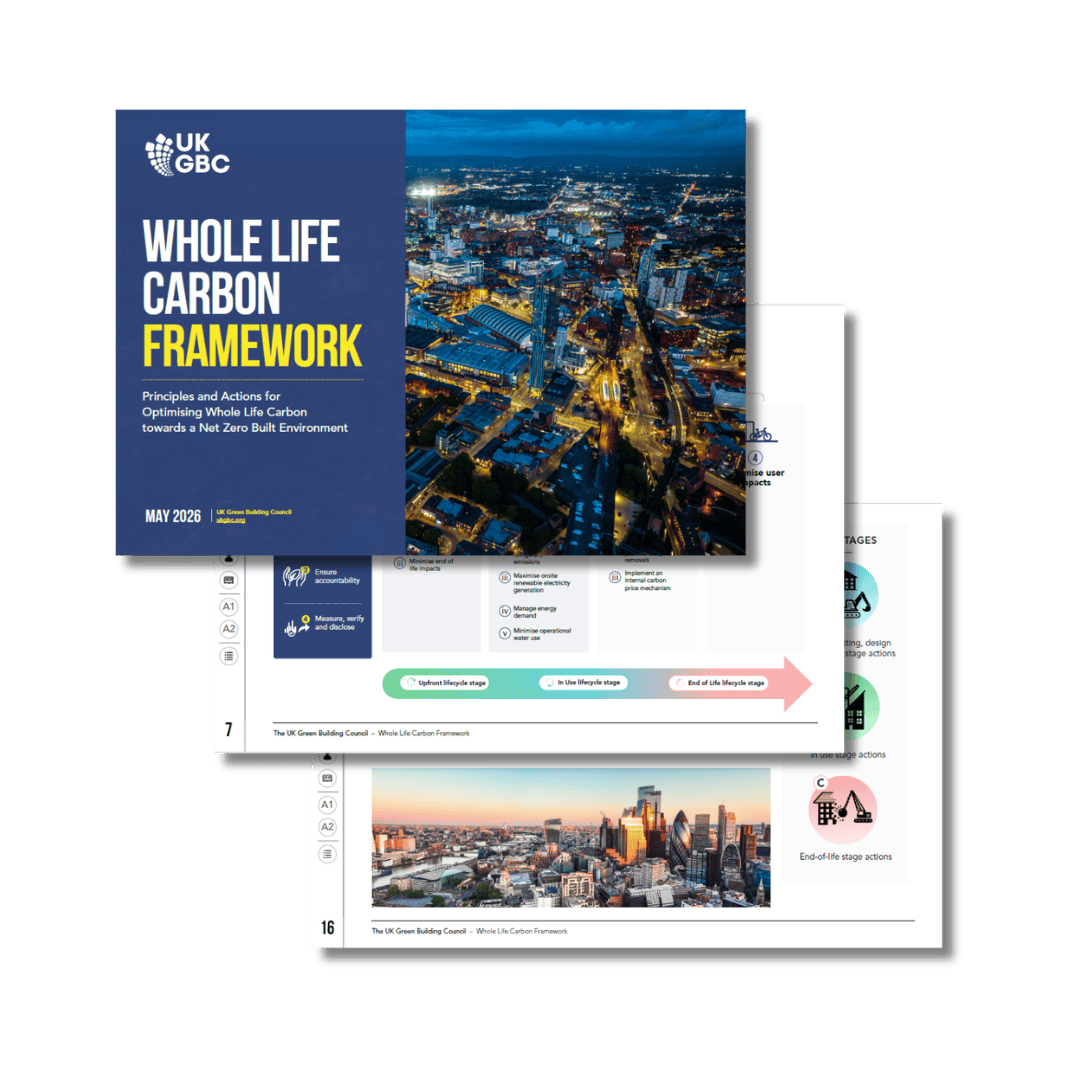
The framework provides:
This framework should be used to:
Advancing Net Zero Partners
Our Advancing Net Zero work is made possible thanks to our programme partners





Whole Life Carbon Framework Project Partners
Thank you to our Project Partners for their continued support




Advancing Net Zero


Climate Change Mitigation


Related
Low-embodied carbon steel cladding


Cost and carbon calculator to inform design decisions


