
New report shows how innovation can help transform the UK's existing commercial buildings
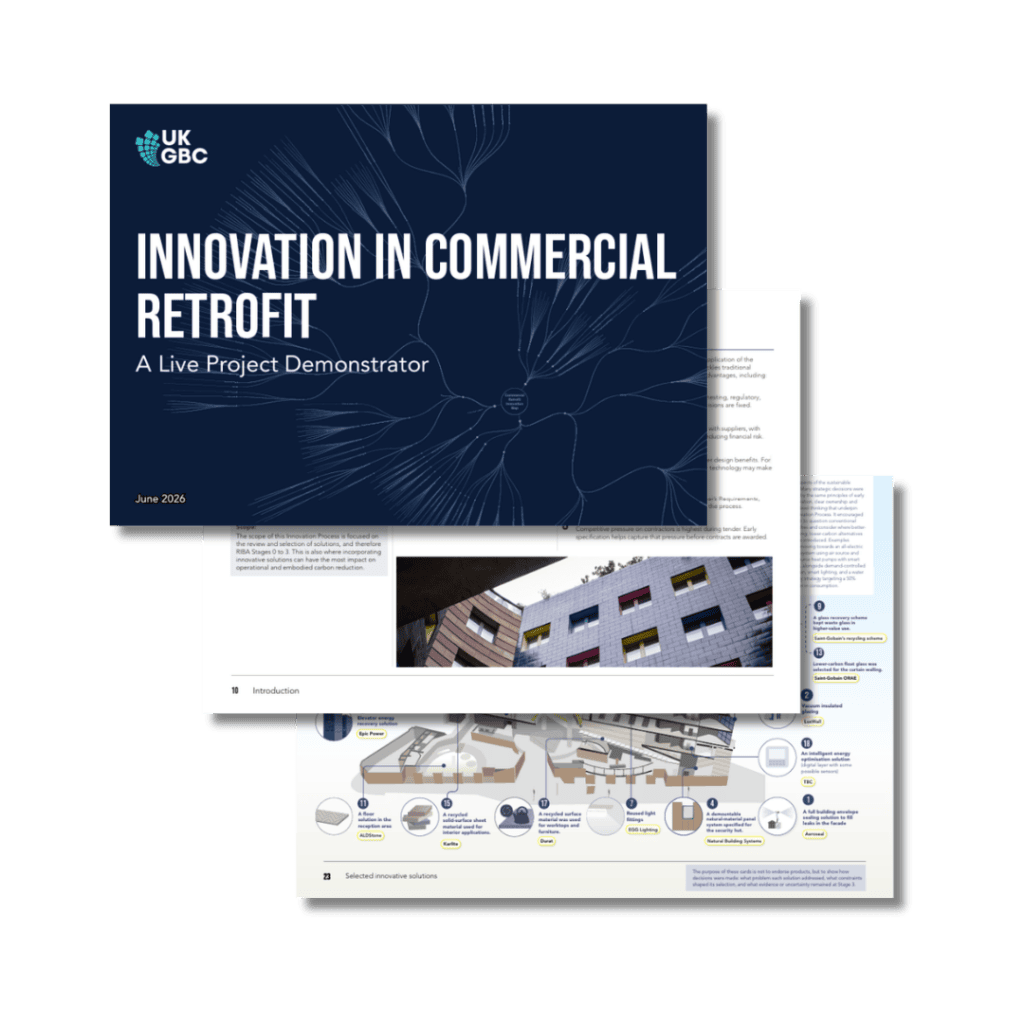
Our report, Innovation in Commercial Retrofit: A Live Project Demonstrator, details the first real-world application of the ‘Commercial Retrofit Innovation Map’ at No.1 Poultry, one of the City of London’s most recognisable buildings.
Despite significant heritage, spatial and commercial constraints of the Grade II* listed building, the report demonstrates how innovation can be embedded from the earliest stages of a retrofit project to deliver ambitious sustainability outcomes. This was achieved through the use of the Innovation Map, an interactive tool, alongside embedding an ‘innovation process’ to ensure the Map was applied diligently and early in the design process.
By cataloguing and organising the retrofit innovation landscape into specific interventions that a low carbon retrofit should consider, the Innovation Map enabled the project team to identify and specify 18 high-impact solutions. This includes an innovative airtightness system, advanced glazing options such as vacuum-insulated glass and a glass recycling scheme, and high-efficiency solar panels that could mean No. 1 Poultry has one of the highest efficiency solar arrays on any building in the UK.
The report sets out a practical ‘Innovation Process’ that encourages project teams to evaluate and engage with innovative technologies at the earliest stages of development, when decisions have the greatest influence on carbon outcomes, cost and performance.
Commercial buildings currently account for nearly a quarter of the built environment’s carbon footprint in the UK through the energy required to heat, power and operate them.
At the same time, the report highlights how growing regulatory requirements, rising energy costs, investors expectations and net zero commitments are increasing pressure on building owners to use ingenuity to drive the performance of existing assets.


The collaborative initiative was established to address a persistent challenge facing the sector: while innovative solutions exist, their adoption is often limited by lack of awareness, perceived risk, fragmented decision-making processes, cost pressure, and insufficient evidence from live projects.
The range of solutions selected for the project are intended to support No. 1 Poultry in achieving industry-leading sustainability outcomes, including BREEAM Outstanding, NABERS 5 Star, EPC A, as well as ambitious operational and embodied carbon targets.
The initiative combines UKGBC’s convening power and innovation champion role, Breakthrough Energy’s innovation ecosystem and climate technology expertise, and FORE Partnership’s experience delivering highly sustainable commercial developments.
Simon McWhirter, Chief Executive of the UK Green Building Council, said:
The UK can’t achieve a net zero built environment without dramatically improving the performance of its existing commercial building stock. This report demonstrates that innovation doesn’t need to be an afterthought.
Rather, by bringing innovative solutions into the decision-making process at the front end, project teams can unlock greater carbon savings, reduce risk and create better-performing buildings. This is all about driving a market change that simply delivers better outcomes – environmental and commercial – for all involved.”
Basil Demeroutis, Managing Partner, FORE Partnership, said:
No. 1 Poultry has shown that even highly constrained and historically significant buildings can become platforms for innovation. Indeed, by proving that innovation can happen even in the most highly constrained cases like No. 1 Poultry, we are proving that commercial retrofit can deliver both environmental and commercial value in every building, so long as sustainability and ingenuity are embedded from the outset.”
Building on the success of this initiative, UKGBC, Breakthrough Energy and FORE will continue to champion innovation-led retrofit across the built environment sector. The partners are seeking to work with more organisations that want to adopt and help develop the Innovation Map, expanding its use across live projects and strengthening the evidence base for innovative retrofit solutions. By creating a clearer pathway from emerging technologies to deployment, the initiative aims to help make innovation a standard part of commercial retrofit practice rather than the exception.
The Initiative


Related
UKGBC launches a Commercial Retrofit Innovation map


UKGBC announces new innovation initiative with Breakthrough Energy and FORE Partnership
BuildingLife Campaign: Could a Circular View Square Industry and Government Priorities?


Shaping Change Together: Collaboration and Leadership in the Built Environment

