Resilient by Design: Putting Adaptation Back into the Climate Equation
Last week I wrote to the Financial Times to make a simple argument: that adaptation has long been the neglected half of climate policy, and that this summer’s overheated hospitals, disrupted railways and closed classrooms show that resilience is an economic issue, not merely an environmental one. Cutting emissions does not remove the need to prepare for the climate that is already here. That argument was about our infrastructure, but it applies to the built environment in its entirety, because the infrastructure described in that letter does not exist in isolation from the buildings around it, and neither government’s response nor industry’s should treat buildings’ resilience as a standalone problem.
Heat does not stop at the platform edge or the hospital car park. A railway line that buckles in extreme heat sits alongside homes that overheat for exactly the same reason: both were designed and built for a climate that no longer exists. A wildfire burning outside a town ( as many communities across Europe, and even in the Scottish Highlands have experienced this month) is not a rural problem separate from the built environment; it is a direct threat to the homes, water supplies and infrastructure at the urban edge. A flooded substation and a flooded high street are symptoms of the same underlaying failure to plan for the climate conditions our infrastructure and buildings will actually face over their lifetimes, rather than the ones assumed when they were designed. Britain’s buildings, transport and drainage were never designed for the risks now arriving, but our buildings, transport and drainage are three expressions of the same system.

Treating them as separate policy conversations, run by separate teams and funded through separate budgets, is precisely how resilience keeps ending up as the neglected half.
Some of the sharpest leadership on this is already coming from City Hall. Sadiq Khan’s Heat Ready London plan, launched this summer, is the clearest example yet of a mayor treating heat as a whole-system issue rather than an emergency response: retrofitting the highest-risk homes, protecting the most vulnerable Londoners and building resilience into the fabric of the city rather than reacting only once a red warning is issued. It is exactly the joined-up thinking this argument calls for, and it is a template that should not stay within the M25.
The need for a joined-up response is not a new observation for UKGBC. It is the argument at the heart of the BuildingLife Ambassador Campaign: that mitigation, resilience and nature recovery are interdependent outcomes of a single system, not three items on a checklist to be worked through independently. A building that meets its carbon target but cannot cope with heat or flood risk has not solved the problem it was set up to solve. The same is true in reverse. Infrastructure resilience delivered without regard to the buildings it serves, or built environment policy delivered without regard to the wider infrastructure it depends on, will always fall short of what the moment demands.
That is why UKGBC’s Net Zero Whole Life Carbon Roadmap and the UK Climate Resilience Roadmap matter so much, and why this campaign matters now. Together, they provide the clearest picture yet of what a genuinely future-ready built environment requires: not just lower emissions, but buildings and places that can withstand the climate impacts already locked in. The Whole Life Carbon Roadmap gives industry and government a common pathway to decarbonise the built environment at pace, while the UK Climate Resilience Roadmap sets out the urgent policy changes needed to embed adaptation into everyday decisions, from planning and design to retrofit and investment. Without both these shifts happening in lockstep, we risk leaving people, places and infrastructure exposed to the impacts of a changing climate.
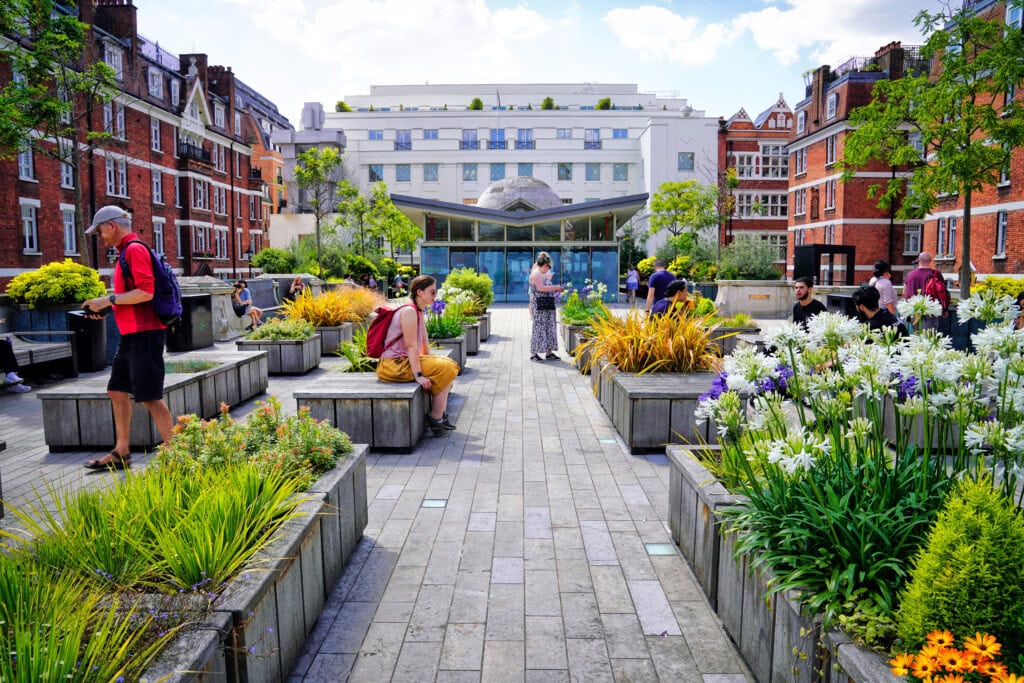
Adaptation should not be framed only as a Treasury exercise in reducing future liabilities. It is an investment in national prosperity, and the same is true of well-designed buildings. Well-designed adaptation restores nature, strengthens infrastructure, improves public health and underpins growth. Retrofit that improves thermal performance protects people from both winter cold and summer heat. Sustainable drainage integrated into new development protects the building and the street around it. Nature based solutions on and around buildings cool the surrounding area as well as the building itself. None of this is exotic. Much of it is already understood by the industry and demonstrated by the leadership pockets we see across the sector. What is missing is the whole system approach that would let this leadership become the norm rather than the exception.
That whole system approach cannot be delivered by industry alone, and it cannot be delivered by government alone either. This is where cooperation must move from aspiration to practice. Government sets the framework within which investment decisions get made: building regulations, planning policy, infrastructure investment criteria, and the price signals that determine what gets built and retrofitted, and to what standard. Industry holds the delivery capability, the technical expertise and the capital that can put those frameworks into action at scale. Neither can substitute for the other, and progress so far has been too dependent on individual leadership on both sides rather than being built into how the system operates.
The Climate Change Committee has repeatedly warned that progress remains inadequate. But evidence is no longer the barrier, leadership is.
Every major public investment should be assessed against the climate conditions it will face over its lifetime, and that principle should apply equally to every major building investment and retrofit decision, public and private, and it should be embedded across government, from Treasury spending decisions to planning and infrastructure policy. That means writing resilience requirements into planning policy and building standards with the same seriousness currently given to carbon, rather than treating adaptation as a follow up conversation once mitigation targets are settled.
With a new government now setting its priorities, the opportunity to embed that principle across policy is real. That government is led, for the first time, by a former mayor, and as Prime Minister Andy Burnham brings regional mayors into the newly revived National Economic Council, there is a genuine chance to turn heat resilience from a patchwork of local responses into a national mission. Burnham has seen the impacts before: as Mayor of Greater Manchester in 2018, Burnham visited crews fighting the Saddleworth Moor wildfires and had to press central government for air support and for assistance with the response costs. I would love to see the regional Mayors work together on preparing for the effects of extreme heat at a national scale now that one of their own leads the Government, rather than each simply reacting once a heatwave hits. Leaders met at the Council’s first sitting last week; I hope heat resilience was firmly on the agenda, and that it becomes part of the Government’s ten-year plan for growth.
The evidence is no longer the barrier. What is needed now is the cooperation between and within government and industry to act on it.
As the Guardian observed, the new Prime Minister has said much about a politics rooted in place but little yet about the climate crisis, when its impact on the places we live should make this an urgent priority. Failing to close that gap would mean another parliament in which resilience investment continues to lag behind mitigation, planned and funded as though the two were unrelated. UKGBC’s Roadmaps exist to close that gap, and the BuildingLife Campaign exists to turn that evidence and ambition into policy change before the window for avoiding additional harm narrows further.
Building resilience into today’s decisions is not an additional cost, but rather the foundation of long-term economic security. The evidence is no longer the barrier. What is needed now is the cooperation between and within government and industry to act on it.
Related
AGM 2026 Results


BuildingLife Campaign: How to Move from Climate Risk to Climate Resilience


UKGBC responds to Ed Miliband’s UN General Assembly Statement


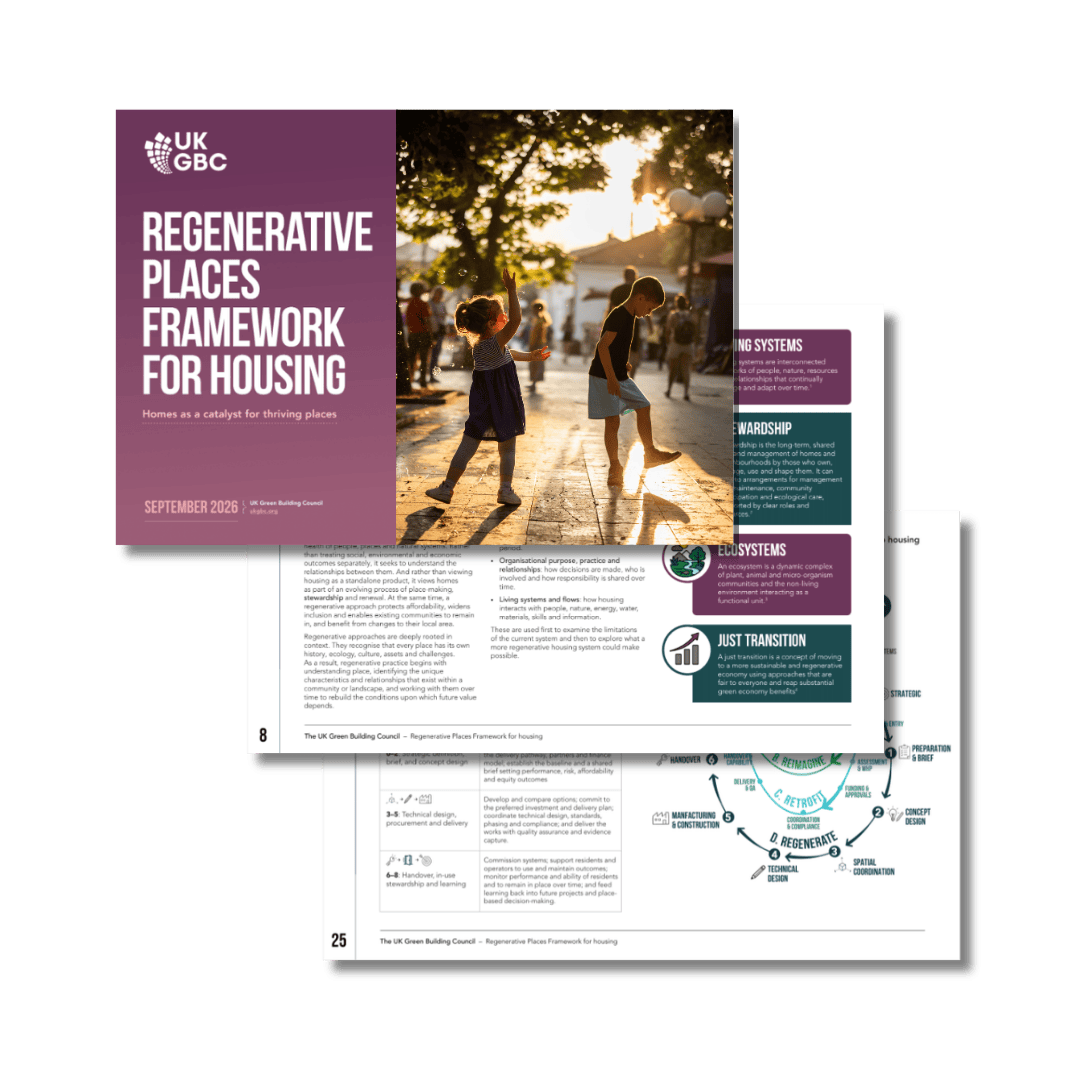
UKGBC launches Regenerative Places Framework for Housing