
UKGBC responds to the Autumn Budget 2026


A green transition in our homes and buildings is delivered by manufacturers, installers, lenders, housing providers and local teams, and each of them plans and invests only as far as policy lets them see. This Budget offers a welcome new financing tool, some help with bills and a promising new framework for data centres. It also removes £1 billion from the Warm Homes Plan, raises the cost of the measures households need to upgrade their homes, and leaves too many questions about the long-term pathway unanswered.
For a market that is still being built, that combination matters. Capacity, skills and investor confidence take years to establish and can be damaged in a single fiscal event.
Simon McWhirter, Chief Executive of UKGBC, said:
We were pleased to hear the Chancellor’s recommitment to the Net Zero 2050 target. The Warm Homes Loan Scheme is a welcome and pragmatic step towards a retrofit market that can increasingly stand on its own feet, giving more households a route to fund heat pumps, solar and other upgrades.
But any overall reduction to housing upgrade funding is dangerous, and with the details of the Warm Homes Plan cuts in this area still unclear, industry needs Government to provide clarity as soon as possible. Manufacturers, installers and local delivery teams will invest and upskill where they can see a stable pathway ahead. This Budget offers some important steps forward for our sector, but overall, this package doesn’t give the long-term certainty needed to drive the transition at pace.”
Decarbonisation: Homes & Heat
The Budget takes £1 billion of capital out of the Warm Homes Plan. The Boiler Upgrade Scheme bears the largest share, at around £720 million, with a further £180 million cut from low-income schemes from 2028 and £100 million from heat networks this financial year. The Treasury says the majority of funding for low-income households and social housing, delivered by mayors and councils, is protected, and that the Boiler Upgrade Scheme will stay at £400 million in 2027/28, rising broadly with inflation thereafter. A broad commitment is not a pathway.
This is a difficult decision to defend. The Warm Homes Plan gave manufacturers, installers, housing associations and local authority retrofit teams a framework to invest against, and many have hired, trained and expanded capacity on the strength of it. Grants exist to carry a young market until scale and competition bring costs down, and we have not yet reached that point. Cutting support part-way through that journey risks stalling the very cost reductions the government wants, the reduction in low-income schemes from 2028 will make it harder for councils and social landlords to plan multi-year programmes, and the loss of heat network funding weakens one of the most promising tools for decarbonising dense urban areas.
Cutting funding while VAT on energy saving materials reverts to 5% from April 2027 sends a mixed signal about whether government wants these upgrades to become cheaper or not. Stability is not a luxury for a market at this stage. It is what allows it to scale.


Finance and Affordability
The Warm Homes Loan Scheme is an important step. Government-backed finance can reach households who are willing to borrow but cannot find the upfront cost of heat pumps, solar and batteries, and it points towards a market that relies less on public subsidy over time. But loans must complement grants rather than replace them, because those under the greatest pressure from energy bills are the least able to borrow. Finance products also need time to build consumer confidence, which is why they work best when grants and loans develop together, with strong consumer protection and trusted advice built in from the start.
The VAT cut on electricity now runs to July 2027, a £100 Household Energy Payment will reach English households in council tax bands A to D, and gas standing charges are to be abolished. These measures help, but the remaining policy costs have not moved off electricity bills and the VAT cut remains temporary, which are the changes that would improve the economics of electrification. A one-off payment eases a winter, whereas a permanent shift in the price of electricity relative to gas would change the decisions that households, landlords and developers make for decades.


Data centres: a promising covenant
The new Data Centre Covenant is a promising step. It asks data centres to pay their fair share of energy costs, support grid flexibility and clean power, agree Local Benefit Plans with the communities that host them, publish annual energy and water reports, protect nature, and capture waste heat for nearby homes, schools and hospitals where practical. In return, strategic data centres that meet these tests will get faster access to grid connections. Linking government support to what a development gives back to its place is a principle the built environment sector has long argued for.
The detail will decide whether it delivers. The definition of a strategic data centre is still to come, the tests are a condition of enhanced support rather than a requirement for all, and heat capture only “where practical” risks turning a major opportunity for local heat networks into an afterthought, particularly when heat network funding has just been cut. We will also want to see whole life carbon and the quality of the buildings themselves addressed, and temporary on-site generation kept tightly limited, where powered by fossil fuels.
UKGBC is looking to convene members on how data centres can be delivered to minimise their downsides and realise positive impacts for the places that host them, from energy and heat to nature, water and community benefit. We will share more as it develops, and we would welcome conversations with members and government.


Climate Resilience and nature recovery
There is little in the Budget to protect buildings and places from impacts already arriving, from overheating homes to flooding. Resilience measures are cheapest when they are built into retrofit and new development rather than added later, which makes the squeeze on retrofit funding a missed opportunity as well as a gap. This is a gap the 2027 Spending Review must fill.
On nature, Biodiversity Net Gain becomes mandatory for nationally significant infrastructure projects from November 2026, which we welcome. We are far less convinced by the exemption for residential brownfield sites of up to 1.5 hectares. Faster delivery of homes matters, but weakening one of the few mechanisms that secures measurable nature recovery risks losing it on exactly the urban sites where people most need access to nature. It also sits awkwardly beside the Data Centre Covenant’s expectation that new development will protect nature, and we will look closely at the impact assessment when it is published.
Better place-making
A further £1.5 billion for social and affordable homes, taking the programme above £40 billion, is welcome, and government should use its role as client to ensure those homes are built to high performance standards. The commitment to no major changes to building regulations for the rest of this Parliament gives developers certainty but it must not become a freeze on ambition, particularly when embodied carbon is still a glaring blind spot.
The £285 million for Good Growth Funds and a £1.5 billion borrowing facility for mayors from 2028 could transform regeneration, provided lending supports work that is sustainable, nature-positive and socially beneficial, and can sit alongside retrofit rather than apart from it. Places are not improved by new buildings alone, and the best regeneration brings upgraded homes, infrastructure, green space, and local jobs together.


What industry needs
Across every one of these areas, the message is the same. Industry needs grants that last long enough to build a market, finance that widens access, and a workforce with the skills to deliver, all backed by a pathway it can plan against. Manufacturers, installers, housing providers and developers have shown that they will invest when government gives them a clear direction, and that the reward can be lower bills, warmer and safer homes, more resilient places, and good jobs in every part of the country. We stand ready to work with government to build that certainty.
Policy & Advocacy


Related
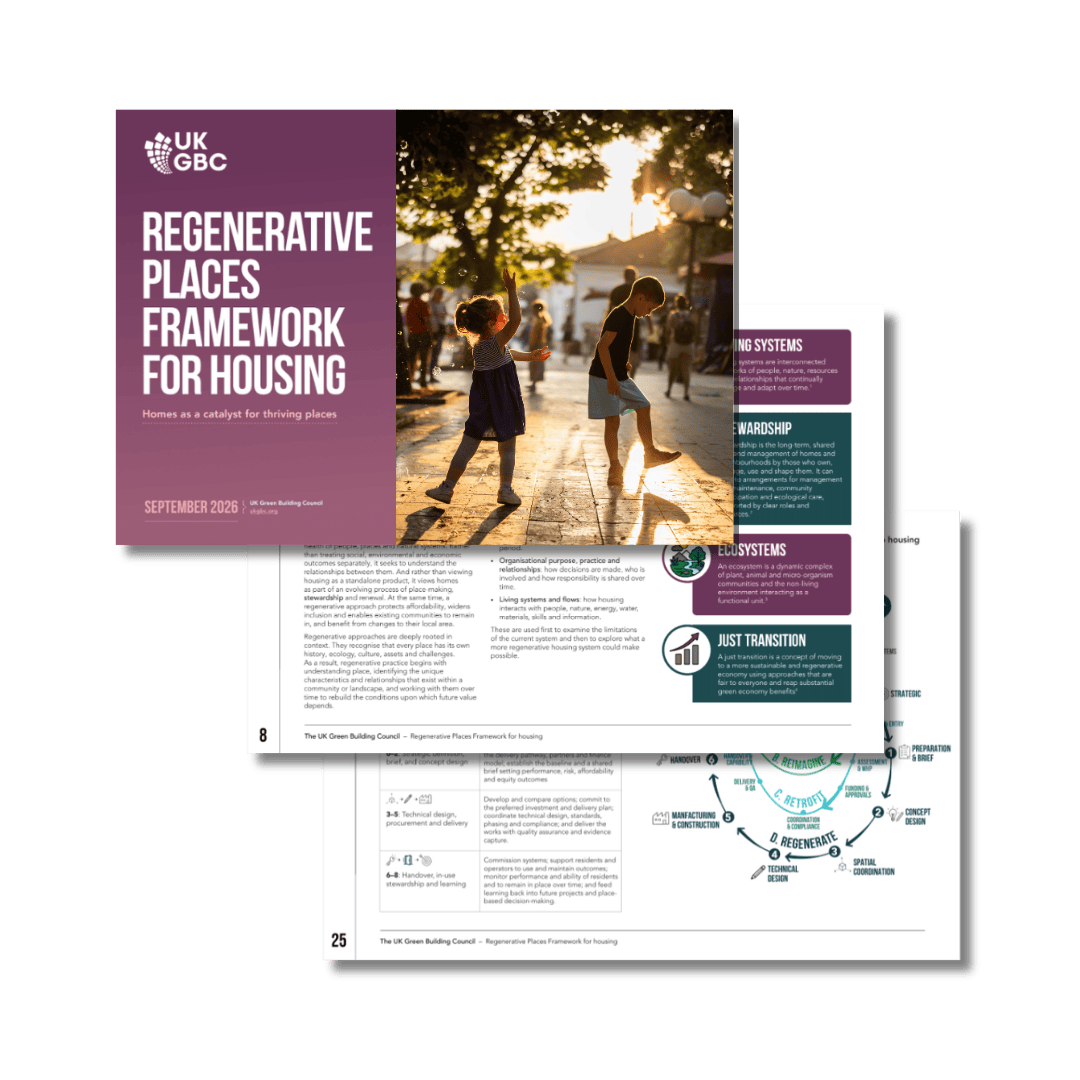
UKGBC launches Regenerative Places Framework for Housing

UKGBC responds to the CCC’s Scotland Progress Report


UKGBC Trends Report signals growing focus on resilience across the built environment


UKGBC responds to the Government’s Autumn Budget 2025