
'Built environment is ‘dangerously behind’ in helping UK meet its carbon targets, UKGBC report warns


New analysis from our latest Whole Life Carbon Roadmap Progress Report has revealed emissions from buildings and infrastructure have fallen by barely half required to meet carbon cutting targets.
The report warns the UK’s built environment, the country’s second-largest source of carbon emissions, is falling dangerously behind the pace required to help meet the UK’s net zero commitment, as defined in the UKGBC’s Net Zero Whole Life Carbon Roadmap.
The report shows carbon emissions falling by 14 per cent since 2018 against the 24 per cent reduction required in the roadmap. It means that, with its current trajectory, the industry is cutting carbon at around half the speed needed – a gap of around 20 MtCO₂e each year, or equivalent to the emissions of heating nine million homes for a year.
To get back on track, the sector must now deliver a further 35 MtCO₂e reduction by 2027, meaning emissions cuts will need to happen more than three times faster than they have so far.
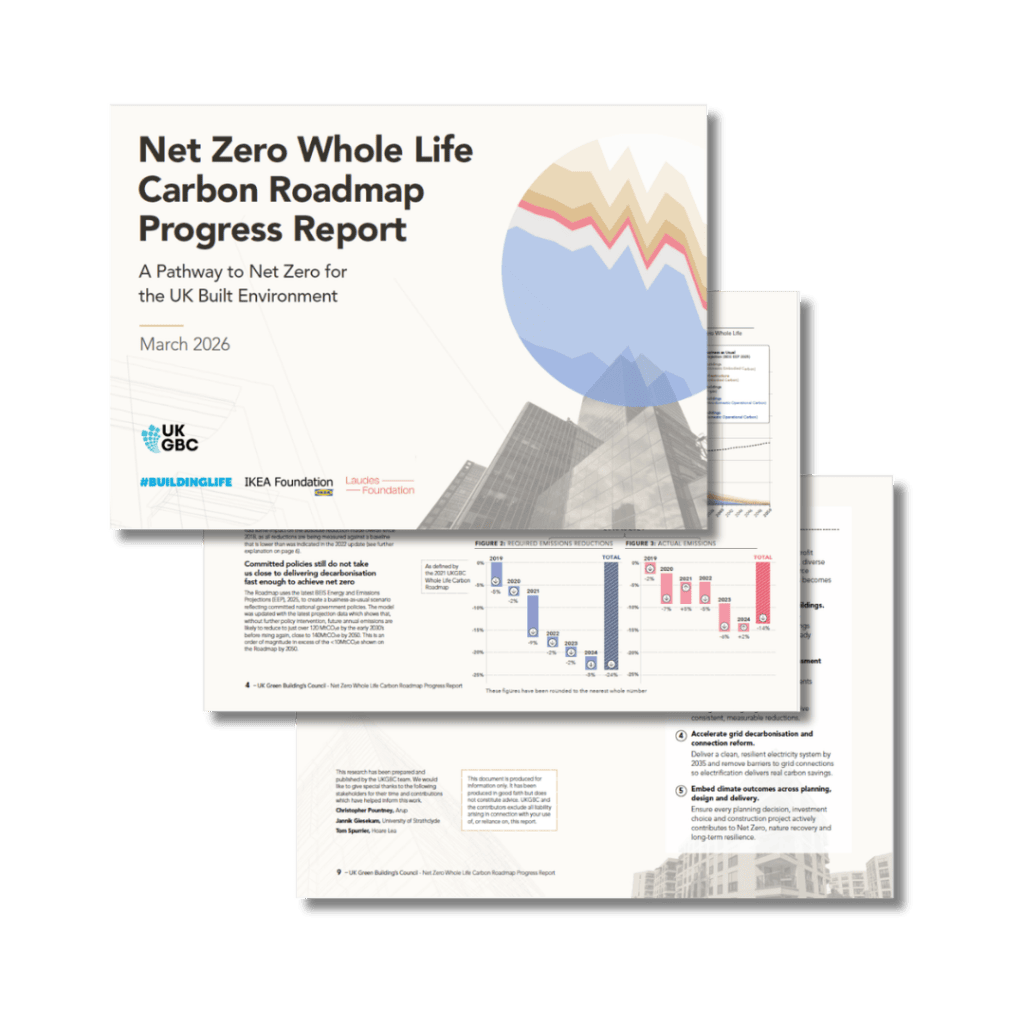
Launched in 2021, the UKGBC’s Net Zero Whole Life Carbon Roadmap, sets out the UK’s pathway to net zero across operational and embodied carbon emissions from buildings and infrastructure. The latest progress report shows where the sector is accelerating and where it is falling behind in helping the UK reach its net zero target.
Operational emissions are falling through better energy efficiency and wider use of low-carbon technologies, the report showed. However, slower progress in embodied carbon reduction is cancelling out those gains.
The report also warned delays in decarbonising the electricity grid were undermining the shift to electrified heat and transport.
The findings come a week after the launch of the UK Net Zero Carbon Buildings Standard, the first unified, science-based method for defining and verifying net zero buildings, including mandatory limits on operational and embodied carbon. The UKGBC will also update its Whole Life Carbon Framework Definition this spring, further strengthening consistency across whole-life carbon assessment. Together, these developments and the publication of the Progress Report, provide the industry with clear evidence base and direction for future investment, design and regulation.
Simon McWhirter, Chief Executive of UKGBC, said:
The UK’s buildings are now dangerously behind in meeting our climate targets, and this new analysis shows just how stark the challenge has become. We are cutting carbon at less than half the pace required and every year we fall further behind, the harder and more expensive it becomes to catch up.
We simply cannot afford to lock in another generation of high-carbon homes, offices and infrastructure. With the right policies and decisive action from government and industry, we can still turn this around, but the window is closing fast.”
Yetunde Abdul, Director of Industry Transformation at UKGBC, said:
The built environment is the UK’s second largest source of emissions, and the solutions are available today. What we need now is consistent policy, mandatory whole life carbon regulation and sustained investment to unlock change at scale. Incremental progress will not be enough; this requires systemic transformation.
The report concludes that while progress has been made since 2018, it falls short of what is required. With no scope to delay progress towards 2050, rapid and coordinated action from industry and government is now essential. UKGBC will continue to convene members, provide evidence-based tools and work with policymakers to accelerate delivery at the pace and scale required.”
This project is part of WorldGBC’s #BuildingLife collaboration, supported by the Ikea Foundation and Laudes Foundation.
Related
Built environment must decarbonise nearly twice as fast by 2025, says UKGBC analysis


Lessons from Conference Season 2026


AGM 2026 Results


BuildingLife Campaign: How to Move from Climate Risk to Climate Resilience